What is binaural audio?
On this website, all is turning around the term “binaural” and therefore this post is dedicated to explain this word.
But before we look into the details, I would like to clearly define the term “binaural”.
First, the term “binaural” is used in psychology. There he describes the localization of sound in space, but also especially the so-called “binaural beats”. This is an acoustic illusion that is perceived when both ears are supplied with sound at slightly different frequencies. Unlike beat frequencies, binaural beats are not produced by the superposition of sound waves in the ear, but in the brain. They are used not only to explore the sense of hearing but also to stimulate brain waves to stimulate relaxation, sleep, meditation or concentration.
Second, “binaural” in the context of hearing aid fitting means when both ears receive a hearing aid.
However, I am referring here exclusively to the third, the sound technical meaning. In this context I refer to the binaural sound recording. To this day, it is the only way to reproduce the sound field of the recording room in all three spatial dimensions, i.e. really spatially, along with Ambisonics and WFS-Holofonie.
Ethymologie
The Latin prefix bi means two. Aural, from the Latin auris, means: what is relative to the ear. Binaural listening therefore refers to listening with two ears, which corresponds to our natural listening. This is why the so-called binaural technique approaches a three-dimensional reconstruction of the sound environment, as in real life.
Psychoacoustic Phenomena
To be able to locate a sound in space, our brain analyzes three fundamental psychoacoustic phenomena: the differences in time and intensity between the sound waves that arrive on each of our ears, as well as monaural cues.

Let’s take an example: if a sound source is in front of me on my right, the sound wave emitted will arrive first on my right ear and will arrive with a slight delay on my left ear. The sound intensity will be louder on my right ear than on my left ear (my head acting as an acoustic obstacle) and we will 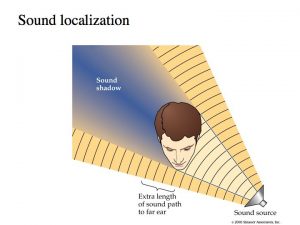 perceive the sound object with a particular timbre.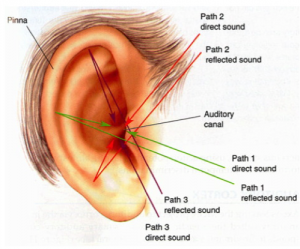
Now, if this sound object is now located at the back on my right, the differences in time and intensity will be about the same as in the previous example, but the timbre will be modified. This is the particularity of binaural compared to stereophonic sound recording: spectral cues. It is thanks to this that the binaural allows hearing in three dimensions and allows to differentiate the back from the front and the top from the bottom.
The binaural recording technique records the sound that falls into the ears in the same way as it is perceived by the human hearing organ. The sound signals obtained in this way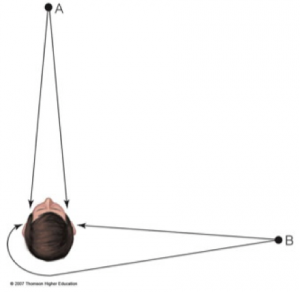 are reproduced using headphones. In this way, external influences on the sound are eliminated. The recording can use an dummy head or even a torso with different details or use the sound engineer’s own head. The sound engineer can move during the recording. The dummy head microphone, on the other hand, is usually kept stationary.
In this way a remarkable realism can be achieved. This, however, is limited by the restriction of head movement and the enclosing effect of headphones. The happy listener therefore gets a good match and impressive realism.
What is the difference between binaural audio and stereo?
Stereo
In general, stereo sound recordings are mixed exclusively using loudspeaker systems during listening; hence the name “loudspeaker stereo”. The properties used by humans for localization, such as the shape of the head or ear, are rightly not taken into account, because in natural hearing and in reproduction via stereo speakers, the ear forms the aural signals itself.
On a regular stereo system with speakers (not headphones), the listener’s left ear will hear both speakers and the right ear will hear both speakers too. If the left ear hears only the left speaker and the right ear hears only the right speaker, there is no crosstalk. In other words, crosstalk occurs when the left ear also hears the right speaker and the right ear also hears the left speaker. So when a listener hears a stereo signal through headphones, there is no crosstalk and the left and right channels are completely separated. Thus, the intended listening experience of a sound engineer mixing with speakers will differ significantly due to the lack of crosstalk when listening through headphones. The sound sources are lateralised and there is typically a loss of energy in the centre of the sound image compared to the loudspeaker reproduction of the same recording. The localization is therefore considerably limited. The sound sources reproduced in this way are localized in the middle of the head.
Binaural
The term “binaural” is unfortunately still confused with stereo because it also consists of two audio channels.
However, in contrast to stereo playback via headphones, binaural signals contain the crosstalk of sound signals described above. These are embedded spatial indications in the form of time, intensity and spectral coloration. These signals imitate and improve natural human localization. The target reproduction system for binaural signals is primarily headphones. When properly recorded, synthesized and reproduced, binaural signals produce a convincing impression of spatial sounds as they occur in the natural listening environment.
Techniques to create Binaural Sound
There are two main methods for creating binaural sound: either directly at recording, it is called native binaural or binaural recording, or at post-production, it is binaural synthesis or binaural by signal processing.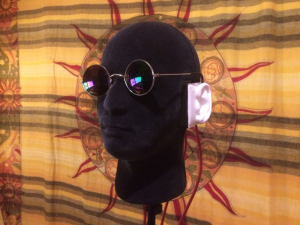
The native binaural is based on a simple principle: the goal is to reproduce as accurately as possible the psychoacoustic phenomena mentioned above. To do this, microphones are placed as close as possible to the eardrums to take advantage of the diffraction, absorption and reflection phenomena that occur on the heads and earpieces.
The principle is therefore to place small microphones in the ears of an artificial head (you can see many pictures of the head “Fritz”, my homemade binaural head).
Signal-processed binaural uses software based on the wave equations of classical acoustics. These algorythms attempt to describe acoustic phenomena with a mathematical approach. All you have to do is position the sound source where you want it to be using software!
